
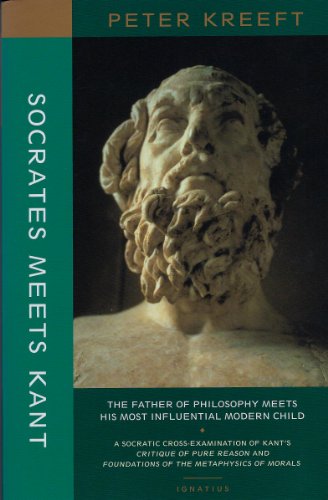
Socrates meets Kant : the father of philosophy meets his most influential modern child : a Socratic cross-examination of Kant's Critique of pure reason and Foundations of the metaphysics of morals / Peter Kreeft.
Material type: TextPublication details: South Bend : St. Augustine's Press, 2020.Description: 326 pages ; 22 cmISBN:
 - 9781587318344 (paperback)
- B2798
| Item type | Current library | Collection | Call number | Status | Date due | Barcode | Item holds | |
|---|---|---|---|---|---|---|---|---|
 Books
Books
|
JST Library General Stacks | B<br>Philosophy (General) | B 2798 KRE (Browse shelf(Opens below)) | Available | 114927 |
Browsing JST Library shelves, Shelving location: General Stacks, Collection: B<br>Philosophy (General) Close shelf browser (Hides shelf browser)


"Immanuel Kant is one of the greatest philosophers in history. As Peter Kreeft here notes, Kant is really two philosophers - a philosopher concerned with how we know things (epistemology) and a philosopher of right and wrong (ethics). If he had written only on either topic, he would still be the most important and influential of the modern philosophers. The combination of the two, though, makes for a formidable thinker, one it would take a figure such as Socrates to confront. Kreeft's Socrates reflects what the historical philosopher would likely have made of Kant's ideas, while also recognizing the greatness, genius, and insightfulness of Kant. The result is a helpful, highly readable, even amusing book. Kant's philosopher of knowing truly is a "Copernican revolution in philosophy," as he himself dubbed it. His ethics intended to set out the rational grounds for morality. Did he achieve his goals? What would Socrates say about the matter?"--
There are no comments on this title.