
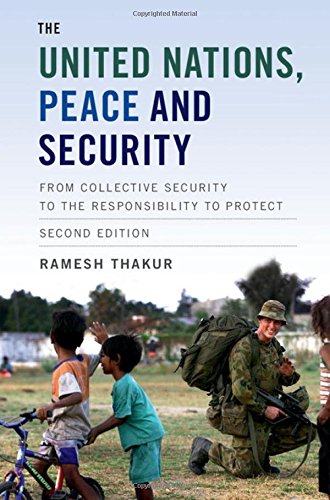
The United Nations, peace and security : from collective security to the responsibility to protect / Ramesh Thakur ; with a foreword by Gareth Evans .
Material type: TextPublication details: Cambridge : Cambridge University Press, 2017.Edition: Second editionDescription: xviii, 428 pages : illustrations ; 24 cmISBN:
 - 9781107176942 (hardback)
- 9781316627723 (paperback)
- 341.7/2 23
- JZ4984.5 .T43 2016
| Item type | Current library | Collection | Call number | Status | Notes | Date due | Barcode | Item holds | |
|---|---|---|---|---|---|---|---|---|---|
 Books
Books
|
JST Library <strong>Processing Center:<br>This book is currently being catalogued by the Deputy Librarian.</strong> | JZ<br>International relations | JZ 4984.5 THA (Browse shelf(Opens below)) | In transit from JST Library to HIPSIR Library since 14/11/2025 | Donation for MSD | 115374 |
Browsing HIPSIR Library shelves, Shelving location: <strong>Processing Center:<br>This book is currently being catalogued by the Deputy Librarian.</strong>, Collection: JZ<br>International relations Close shelf browser (Hides shelf browser)


Includes bibliographical references and index.
Machine generated contents note: 1. Pacific settlement, collective security and international peacekeeping; 2. Peace operations and the UN-US relationship; 3. Human security and human rights; 4. International criminal justice; 5. International sanctions; 6. The nuclear threat; 7. International terrorism; 8. Kosovo 1999 and Iraq 2003 as unilateral interventions; 9. Afghanistan, Libya and Syria: UN-authorised interventions and non-intervention; 10. From humanitarian intervention to R2P: cosmetic or consequential?; 11. The development and evolution of R2P as international policy; 12. Reforming the United Nations; 13. The political role of the United Nations Secretary-General.
"Ending humanitarian atrocities has become as important for the United Nations as preventing interstate war. This book examines the transformation of UN operations, analysing its changing role and structure. Ramesh Thakur asks why, when and how force may be used, and argues that the growing gulf between legality and legitimacy is evidence of an eroded sense of international community. He considers the tension between the United States, with its capacity to use force and project power, and the United Nations, as the centre of the international law enforcement system. He asserts the central importance of the rule of law and a rules-based order focused on the United Nations as the foundation of a civilised system of international relations. This book will be of interest to students of the United Nations and international organisations in politics, law and international relations departments, as well as policymakers in governmental and non-governmental international organisations"--
There are no comments on this title.