
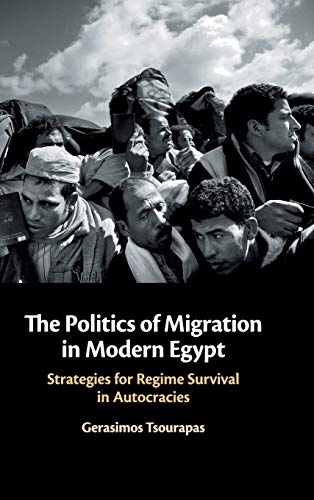
The politics of migration in modern Egypt : strategies for regime survival in autocracies / Gerasimos Tsourapas.
Material type: TextPublication details: Cambridge : Cambridge University Press, 2019.Description: xvii, 246 pages : illustrations ; 24 cmISBN:
 - 9781108475549 (hardback)
- 9781108468640 (paperback)
- 325/.262 23
- JV8989 .T76 2019
| Item type | Current library | Collection | Call number | Status | Notes | Date due | Barcode | Item holds | |
|---|---|---|---|---|---|---|---|---|---|
 Books
Books
|
HIPSIR Library <strong>Processing Center:<br>This book is currently being catalogued by the Deputy Librarian.</strong> | JV<br>Colonies and colonization.<br>Emigration and immigration.<br>International migration | JV 8989 TSO (Browse shelf(Opens below)) | Available | Donation for MSD | 115725 |
Browsing HIPSIR Library shelves, Shelving location: <strong>Processing Center:<br>This book is currently being catalogued by the Deputy Librarian.</strong>, Collection: JV<br>Colonies and colonization.<br>Emigration and immigration.<br>International migration Close shelf browser (Hides shelf browser)


Includes bibliographical references (pages 223-243) and index.
Introduction -- 'Egyptians don't emigrate' : the domestic politics of migration restriction, 1952-1970 -- Exporting the Free Officers' revolution : migration & external regime legitimacy under Nasser -- 'Our most precious asset' : the domestic politics of migration liberalisation, 1970-2011 -- 'The rich hive invaded by foreign bees' : migration & external regime legitimacy under Sadat and Mubarak -- Egypt's road to the "Arab Spring".
"Research on Egyptian politics has long-highlighted an economic rationale behind the President's 1971 decision to lift all emigration restrictions, and to move away from earlier attempts at tight controls: given the penurious state of the Egyptian economy, the argument goes, labour emigration would constitute a "safety valve" against unemployment and overpopulation, while workers' remittances would provide a "lifeline" to the regime. In this sense, Egypt is no different than a large number of developing nations, from India and Mexico to the Philippines and Turkey, who adopted permissive emigration policies in order to either boost their economic indicators or to reduce social tensions by allowing citizens to explore employment opportunities abroad. Yet, if that is the case, why would the Egyptian regime not attempt to fine-tune a policy that appeared to aggravate - rather than resolve - its domestic political economy issues? If labour emigration is solely a tool for economic development, policy-makers are normally expected to anticipate inflationary pressures or labour market imbalances, and to adjust accordingly. The counterintuitive nature of the Egyptian regime's engagement with emigration highlights the need for more nuanced analyses of the relationship between population mobility and political power within non-democratic contexts. Jean Bodin may, in fact, have been right in urging elites to find wealth and strength in citizens' numbers, but the political importance of migration - particularly in authoritarian contexts - remains elusive"--
There are no comments on this title.